Tours to Khunjerab Pass
Ready-made itineraries that visit this destination.
Khunjerab Pass
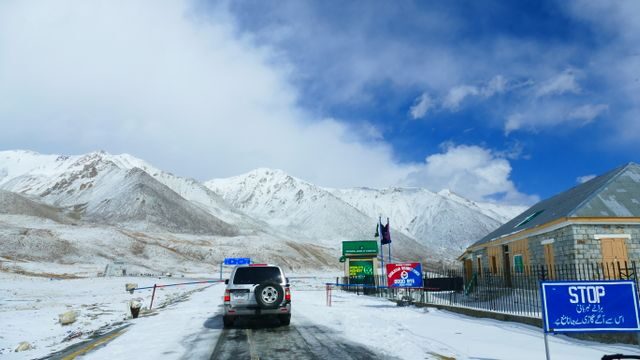
At 4,693 metres, Khunjerab Pass is the highest paved international border crossing in the world - the point where the Karakoram Highway leaves Pakistan and enters China's Xinjiang. It is the northern full stop of almost every Hunza itinerary, a two-and-a-half to three-hour drive above Karimabad through Gulmit, Passu and Sost.
The drive up
From Karimabad the highway runs north past Attabad Lake, the Passu Cones and the Batura glacier viewpoint to Sost, the last Pakistani town and the site of the dry port and immigration post. Beyond Sost the road climbs steadily through Dhee and the Khunjerab National Park gate, where entry fees are collected and ID is checked. The final stretch is wide, smooth and almost empty, with marmots on the verges and the treeline long since behind you.
What you actually see
The pass itself is a broad saddle with the border gate, a monument, and Chinese and Pakistani markers a few metres apart. There is no crossing for tourists without a Chinese visa and the correct paperwork, so this is a viewpoint rather than a transit point for almost everyone. People stay half an hour to an hour - long enough for photographs and a hot drink from the stalls that operate in summer. On a clear day the scale of the plateau is the whole point.
Altitude and how to handle it
Going from Karimabad at 2,500 m to nearly 4,700 m in under three hours is a real altitude gain, and mild headaches and breathlessness are common. The mitigation is simple: do not rush at the top, drink water on the way up, skip it if you already have a bad headache, and treat it as a short visit rather than a long stop. Travellers with heart or respiratory conditions should ask their doctor before including it. Weather at the pass can drop below freezing even in July.
When it is open
Khunjerab is usually open to visitors from around April to late November and closed by snow through winter, with the official border trade season shorter still. Exact dates shift year to year with snowfall. Everyone travelling needs CNIC or passport at the national park checkpost; foreign nationals should carry their passport and any NOC that applies. We confirm the current status before the day rather than driving up on assumption.
Khunjerab National Park and its wildlife
The pass sits inside Khunjerab National Park, one of Pakistan's largest protected areas and home to snow leopard, Marco Polo sheep, Himalayan ibex and blue sheep. Marco Polo sheep are the park's emblem and are occasionally seen on the higher slopes near the border; marmots are guaranteed. Entry fees are collected at the park gate below the pass and go towards conservation. Feeding animals along the road is discouraged for good reason - it changes their behaviour and pulls them onto the highway, where trucks run all summer.
Frequently asked questions
Straight answers to what travellers ask us most.
Can I cross into China at Khunjerab?+
Is Khunjerab Pass open in winter?+
Will I get altitude sickness?+
How long does the trip take from Karimabad?+
Let's plan your trip to the north
Send us your dates and group size. You'll have a clear itinerary and an honest quote before you commit to anything.